


What’s The Best Hitch For My Silverado 1500?
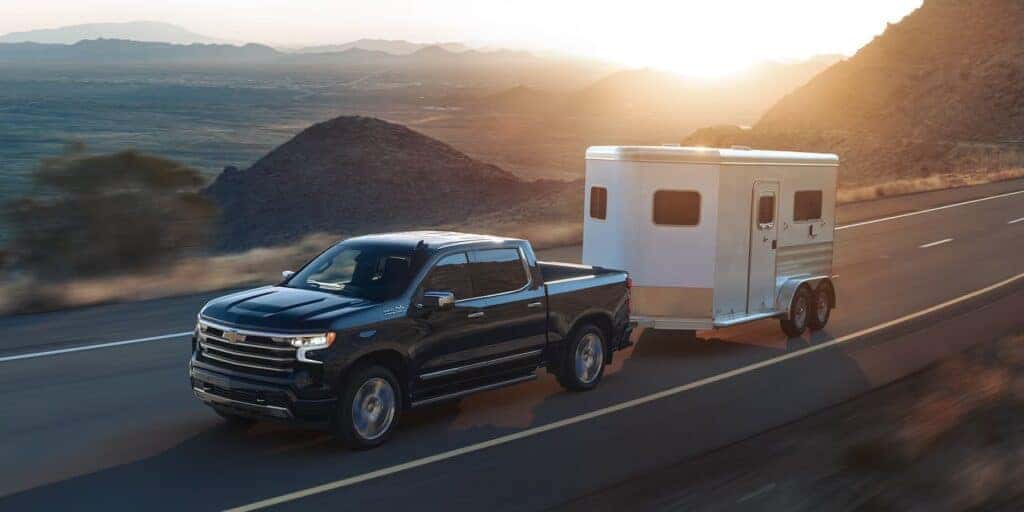
We have all seen some guy pulling a trailer that is noticeably sagging at the hitch. This not only looks bad but is unsafe as well. That kind of downward force on the rear of the vehicle means reduced downward force on the front, which can be clearly seen. This reduces steering traction and reduces front brake effectiveness. Meanwhile, the rear axle and brakes are being overloaded and possibly overheated, which will also reduce rear brake effectiveness. The imbalance also reduces vehicle stability which is bad any time, worse when you are towing. Twin Falls Chevrolet doesn’t want you to be that guy.
When You Should Tow Using a Weight Distribution Hitch
Sagging at the hitch is less likely the result of a vehicle pulling a trailer over its maximum towing capacity than too much tongue weight; that is, the actual amount of trailer weight forcing down on the hitch ball. The ideal tongue weight for a conventionally towed trailer is 10-15% of the total trailer weight. Below 10% indicates too much weight at the trailer rear, which threatens sway and stability issues. More than 15% can result in the sagging described above.
Trailers with fixed content, like those for camping, were likely designed with the ideal tongue weight in this range and will have that figure as part of their specs. Though adding excessive heavy gear in the front or back will change the figure. When working with trailers with variable contents such as cargo, vehicles, or livestock, the tongue weight is entirely up to the load distribution. The solution for this, on Chevrolet’s Colorado and Silverado trucks and truck-based SUVs like the Tahoe and Suburban, is a Weight Distribution Hitch (WDH).
What is a Weight Distribution Hitch?

“Poorly understood, absolutely essential, and seldom used”. That is how Alex Dykes of Alex on Autos described weight distribution hitches. Their purpose is to distribute the tongue weight evenly across the tow vehicle’s front and rear axles as well as to the trailer axle(s), and have the hitch connection parallel with the road. The industry term for this is Front Axle Load Restoration (FALR). Ideal FALR is to return 50-100% of the weight lost from the front axle.
While it may sound like a WDH must extend to the front axle and a trailer’s axle, they don’t, and instead, let the frame of each vehicle do the FALR work for them. It starts with a height-adjustable hitch. Spring bars mount on each side of the hitch ball on one end and mount to each side of the trailer’s front A-frame at about 23 to 35 inches back from the coupler. By rigidly connecting the frame-mounted hitch to the trailer frame, the spring bars force a parallel connection between the tow vehicle and trailer and greatly reduce vertical pivot at the hitch ball. For the tow vehicle, this both levels the body and forces weight back on the front axle. The spring bars are designed to flex enough to enable turning and allow a small degree of vertical articulation to account for uneven surfaces, but always returning to the parallel connection.
Vehicles equipped with rear air springs may seem to alleviate the sagging problem on their own by pumping up the air until the vehicle is level again, but the air springs will not significantly return the weight to the front.
When to Use a Weight Distribution Hitch?
The weight ratio between a tow vehicle and a trailer is always a factor in trailering stability. The greater the trailer weight, the more precautions you have to take. As a general rule of thumb, you should consider using a WDH when the trailer weighs 50% or more than the tow vehicle. For example, a 2023 4WD Silverado 1500 Crew cab / short bed with the 5.3-liter V-8 weighs about 5,070 pounds. Though it has a maximum towing capacity of 9,000 pounds, any trailer above 7,600 pounds should be pulled with a WDH. That assumes the ideal tongue weight of 10 to 15% of the trailer weight. If you anticipate a front-heavy trailer, a lower weight threshold should be considered.
Considerations and Limitations and
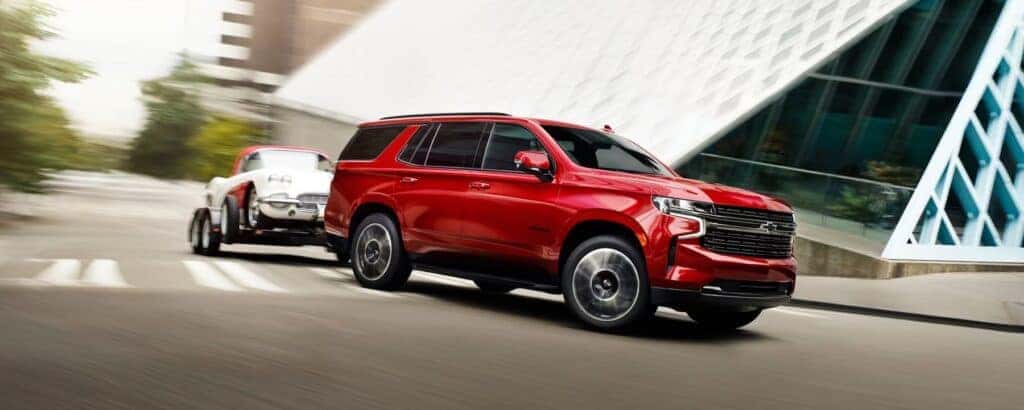
Because of the load WDHs place on the frame, they are not compatible with “Car-based” models with unitized body frames, such as the Equinox, Traverse, and other Chevrolet crossovers. This is another reason why body-on-frame vehicles such as Chevrolet’s pickup trucks and big SUVs make superior tow vehicles. Most trailers with surge brakes are also not compatible with most WDHs.
WDHs do not increase a vehicle’s towing capacity and should always be used within that capacity. More setup is required with a WDH than a conventional hitch. There are settings regarding hitch height and spring bar mounting to consider, and setup requires both the tow vehicle and trailer to be on a level surface. When a trailer has a fixed load like a camping trailer – you can pretty much set it and forget it. But if the trailer or trailer load changes, it will need to be reset with each use.
WDHs generally cost between $250 to $500. That is certainly more than a conventional hitch but probably a fraction of what of either your trailer or tow vehicle, both of which will be better protected by improved towing stability. They take more time and effort to set up, but if you are towing something fairly heavy, a WDH is the way to do it correctly and show you know what you’re doing.
Contact our parts department if you’d like to add a Weight Distribution Hitch to your Chevy vehicle. Our service department can even install it for you. If you have any specific questions about towing with your Chevrolet truck, contact one of our professionals at Twin Falls Chevrolet.
0 comment(s) so far on What’s The Best Hitch For My Silverado 1500?